
The Laboratory Purchase Order That Looked Complete Until the Test Reports Arrived: Why Research Procurement Needs a Paper Trail That Survives Every Handoff
A laboratory purchase order can be complete from an accounting perspective and still leave a researcher unable to establish exactly what arrived. The supplier name is correct, the quantity matches the invoice, and the shipment has been received. Yet when the analytical documentation is requested, a problem emerges: the certificate does not identify the same lot as the material in storage.
That discrepancy is more than a clerical inconvenience. If the records cannot connect a physical research material to the test results claimed for it, the purchasing team has not established what those results mean for the material received. The delivery may be financially complete while the scientific documentation remains unresolved.
Research procurement therefore needs a broader definition of a successful purchase. It must account for the movement of materials, the identity of each batch, the reliability of supporting records, and the questions that arise when information passes between suppliers, receiving teams, inventory systems, and laboratories.
The difference between a completed purchase and a documented material
Commercial purchasing systems are designed to answer operational questions. Was the requested item ordered? Did the supplier fulfill the order? Was the correct quantity delivered? Does the invoice match the agreed price?
Scientific work raises additional questions. Which lot was received? What analytical methods were used to characterize it? When was the analysis performed? Does the reported result apply to this specific material, or to a different batch carrying the same product name?
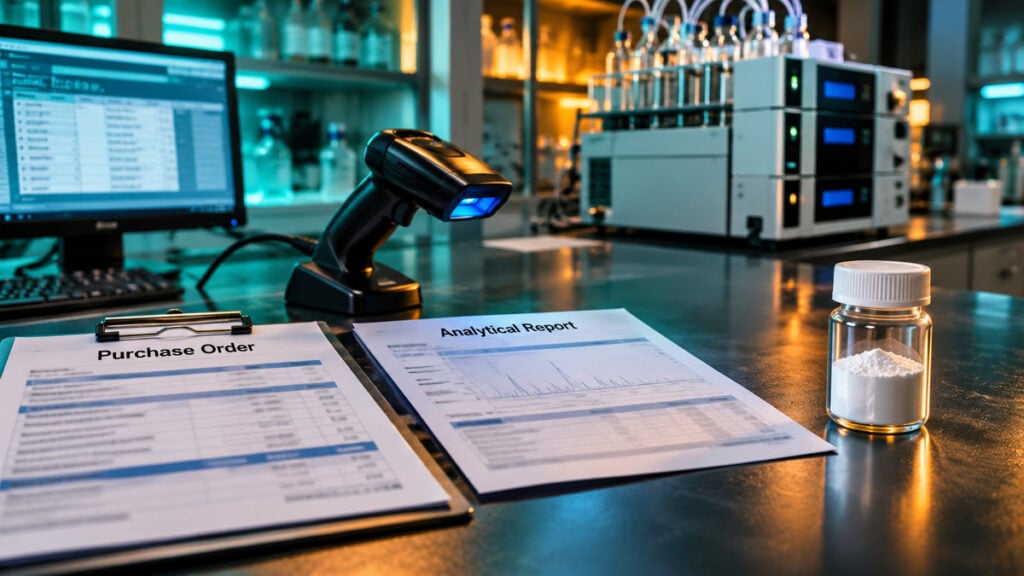
These questions cannot be answered by an invoice alone. A purchase order describes an intended transaction. A packing record describes what was dispatched. An analytical report describes findings about a sample under the conditions of a particular test. None of those documents automatically establishes the information contained in the others.
Consider a research team ordering a peptide for an in-vitro investigation. The name on the order may match the label on the package. However, the analytical report supplied with that order could have been generated for an earlier lot. Unless there is evidence connecting the report to the material received, the team cannot simply transfer the earlier result to the new shipment.
This distinction is visible in educational material published through the research section of usapeptidedepot.com, which discusses product identity, analytical methods, documentation and uncertainty. Those subjects matter because an attractive headline figure cannot replace a traceable record of what was actually tested.
Procurement teams should therefore distinguish commercial acceptance from technical acceptance. Recording delivery is one event. Deciding that the received material satisfies the documentation requirements of an intended research project is another.
Why laboratory records need more than a certificate of analysis
A certificate of analysis can provide valuable information, but its usefulness depends on what it identifies and how clearly the result is reported. The presence of a certificate is not, by itself, proof that all relevant questions have been answered.
For example, a report might identify a compound and give a chromatographic purity result. That information does not necessarily establish its concentration, total content, stability, or suitability for a particular experiment. Those are separate questions that may require different measurements or supporting evidence.
The US Food and Drug Administration addressed the importance of complete and reliable records in its December 2018 guidance, Data Integrity and Compliance With Drug CGMP. The guidance describes data integrity in terms of completeness, consistency and accuracy. It also discusses the ALCOA principles: data should be attributable, legible, contemporaneously recorded, original or a true copy, and accurate.
The FDA guidance is written for regulated drug-manufacturing activities. It should not be interpreted as establishing a universal legal requirement for every research-reagent supplier. Nevertheless, its explanation of reliable records provides useful principles for any organization evaluating analytical information.
A laboratory buyer can apply those principles by asking where a result came from, whether the underlying information can be identified, and whether the report contains enough context to support its interpretation.
The National Institute of Standards and Technology makes a related distinction in its policy on metrological traceability. NIST explains that traceability belongs to a measurement result and depends on a documented chain of calibrations connected to a specified reference. Simply using a calibrated instrument does not automatically make every resulting measurement traceable.
This is especially relevant when a supplier makes broad claims about laboratory testing. A buyer should not assume that a recognizable instrument name, laboratory name or technical acronym explains the complete basis of the reported measurement.
How documents become disconnected during purchasing and receiving
Documentation problems do not always originate in the analytical laboratory. They can arise when otherwise legitimate records move between unrelated business systems.
A purchasing platform may store the supplier’s product identifier, while an inventory system uses an internal stock code. The receiving department may record the shipment reference rather than the manufacturer’s batch identifier. A researcher may then download a report using the product name without checking whether it corresponds to the received lot.
Each individual record may be accurate within its own system. The failure occurs when nobody preserves the relationship between them.
These are common points at which a documentation chain can become difficult to reconstruct:
- Ordering: The requested specification is abbreviated, leaving ambiguity about the exact material or form required.
- Receiving: The goods are logged against an invoice without preserving the full lot identifier.
- Document collection: A report is downloaded by product name rather than matched to the received batch.
- Inventory transfer: Material is moved or divided into secondary containers without preserving its original identity.
- Research preparation: The experiment record refers to a general product description instead of the particular lot used.
None of these problems requires deliberate misconduct. A poorly designed workflow can create them through ordinary administrative shortcuts.
The practical remedy is to make documentation matching a separate checkpoint in the receiving process. A team can begin with how to verify laboratory documentation, including checks of product identity, lot identifiers, issuing laboratories, analysis dates and the methods described in reports.
This does not mean every purchasing employee must become an analytical chemist. It means the process should distinguish questions that receiving staff can answer from scientific questions that require qualified review.
When a discrepancy is identified, the material’s documentation status should remain unresolved until the appropriate person has reviewed it. An accounting system showing that the invoice was paid should not be mistaken for that technical decision.
The cost of discovering a missing record after an experiment
The financial implications of weak documentation are difficult to calculate in advance because they depend on how a material is used, the cost of repeating work, and the significance of the missing information.
For a small research team, an unresolved lot identity may require administrative follow-up before work can proceed. A project operating under more demanding institutional or quality-system requirements may need formal review, corrective records or additional material characterization.
When documentation problems are discovered after experimental work, the consequences can be more complicated. The researcher may have to determine which materials were used, whether the issue affects the interpretation of the results, and whether any conclusions require qualification.
It is not always necessary to repeat an experiment. The appropriate response depends on the nature of the discrepancy and the relevant scientific standards. However, documentation that was never recorded cannot always be reconstructed reliably from an invoice or a shipment date.
Consider two experiments conducted several months apart with materials carrying the same compound name. If the findings differ, researchers may examine many possible explanations, including experimental conditions and material variability. Knowing the exact lot used in each experiment allows material identity to be considered as part of that investigation.
Without the identifiers, an important variable remains unknown.
This is why lot records have value beyond routine warehouse organization. They support investigations into unexpected findings, facilitate comparisons between experiments and help teams identify the scope of a material-related concern.
The underlying logic is described in this explanation of lot traceability, which distinguishes the name of a research material from the records associated with a particular production or packaging batch.
What purchasing managers should require before a shipment is accepted for research
A better procurement process does not need to demand every conceivable laboratory test for every material. Its requirements should be proportionate to the material, the planned research, the available methods and the organization’s own quality system.
The starting point is a clear purchase specification. A procurement request should describe the identity and relevant characteristics of the intended material rather than relying exclusively on a commercial product name. Where a particular form, grade or analytical characteristic matters, the buyer should record that requirement explicitly.
Next comes document availability. Before an order is approved, the purchasing team should establish what analytical records the supplier can actually provide. A certificate that will be issued for the received lot is different from a general sample report intended to illustrate a typical testing format.
The receiving process should then preserve the identifiers needed to connect those documents to the shipment. The exact information will vary by material and supplier, but product identifiers, lot numbers, report references and receipt records are often central.
Responsibilities also need to be clear. Procurement can confirm whether promised documents were received and whether identifying fields appear to match. Scientific personnel can assess whether the tests reported are relevant to the intended research and whether the evidence is sufficient.
Those are different judgments. Combining them into a single checkbox makes it easier for an administrative confirmation to be interpreted as scientific approval.
An effective procedure should also make exceptions visible. Missing reports, inconsistent identifiers and unclear analytical methods should be recorded as unresolved items rather than erased by a later change to the purchasing status.
For organizations handling many research materials, a centralized record can help. It may contain the purchase reference, item identity, supplier, received lot, analytical report reference, review date and disposition decision. The goal is not to create another database for its own sake, but to maintain a reliable connection between the material and the evidence used to assess it.
Traceability should survive staff changes, system changes and the passage of time
Many laboratory records are easy to understand while the people who created them are available to explain their meaning. Their weaknesses become apparent later, when a colleague changes roles, a supplier updates its document library, or an older experiment needs to be reviewed.
A record that depends on someone’s memory is not an adequate substitute for documented material identity. Nor is a folder containing reports without a clear explanation of which received materials they describe.
The FDA’s data-integrity guidance discusses the need to retain contextual information, often described as metadata, so records can be interpreted and activities reconstructed. Its discussion concerns regulated manufacturing, but the underlying problem is familiar across research operations: isolated data values lose meaning when their original context disappears.
Electronic systems can make records easier to retrieve, yet they do not automatically solve this problem. An inventory entry can remain accessible for years while omitting the identifier needed to match it to an analytical result. A shared folder may preserve a report but not the history of how it was assigned to a particular shipment.
Good record design therefore emphasizes relationships. A future reviewer should be able to identify the material, locate the relevant supporting report, understand who reviewed it and determine what was known at the time of use.
For that reason, procurement quality should be evaluated partly by how well records survive ordinary operational change. The process must remain understandable without relying on a particular employee, email conversation or supplier representative.
A successful laboratory purchase is ultimately one that can be explained after the transaction has ended. The material arrives, its identity can be connected to the relevant documentation, discrepancies are preserved for review, and scientific decisions remain separate from accounting completion.
When those conditions are met, the paperwork does more than close a purchase order. It gives researchers a defensible record of the materials on which their work depends.