
Household Cleanouts Got Smaller and Faster. Waste Services Are Still Priced for the Old Job.
A slowing remodeling market is producing more projects of shorter duration, and the rental products aimed at them were designed for a different kind of work
By Clint Sanchez
The residential waste question a household faces in 2026 is rarely the one the rental market is built to answer.
The classic roll-off customer was a homeowner in the middle of a substantial renovation. A kitchen came out over two weeks. A container sat in the driveway the entire time, filling in stages as demolition, framing, and finish work each produced their own debris stream. A seven to 10 day rental window fit that job, and where it did not, an extension day or two closed the gap.
That customer still exists. They are no longer the median.
What the spending data shows
The Joint Center for Housing Studies at Harvard University projects homeowner spending on improvements and repairs reaching roughly $518 billion by the end of 2026, with year-over-year growth easing from about 2.1 percent at midyear to 1.6 percent in the fourth quarter.
The headline number is large while the growth rate is modest, and that combination is more informative than either figure alone. Aggregate spending holding near record levels while growth decelerates is the signature of a market shifting composition rather than contracting. Discretionary whole-room projects are the first spending category households defer when financing costs and economic uncertainty rise. Repair, replacement, and maintenance work is the category that persists, because a failing roof and a flooded utility room do not wait for interest rates.
Spending holds near record levels while the growth rate flattens.
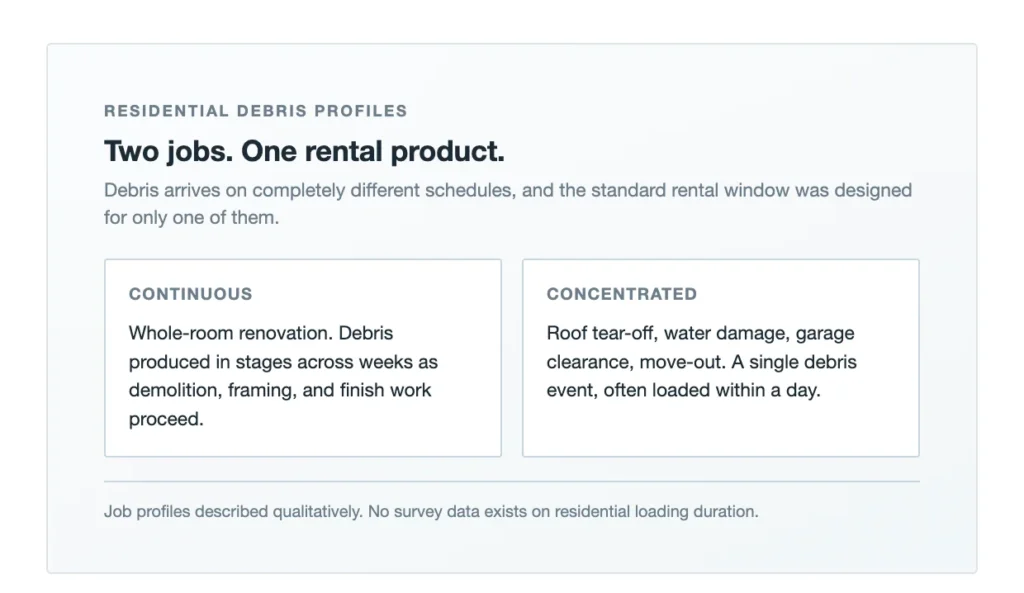
Those two categories generate debris on completely different schedules. A whole-room renovation produces waste continuously across weeks. A roof replacement, a water-damage tear-out, a garage clearance, or a move-out cleanout produces a single concentrated debris event, often loaded within a day.
The substitution nobody planned for
Faced with a one-day debris event and a seven-day rental product, households have been quietly solving the problem by leaving the category entirely.
Full-service junk removal has absorbed a meaningful share of this work, and the reason is not primarily price. Junk removal sells labor and immediacy: a crew arrives, loads the material, and leaves. For a household clearing a single room, a deceased relative’s belongings, or a garage before a move, the loading labor is the actual obstacle, and the container is incidental.
Roll-off rental sells capacity and self-service. For a homeowner with a pickup truck’s worth of material and a free Saturday, it is substantially cheaper per cubic yard. The trade is that the household provides the labor and, under conventional pricing, buys a week of container time it will use for four hours.
That trade has been getting worse in one direction. As jobs shrink, the labor advantage of junk removal grows relative to the capacity advantage of a container, and the unused rental days become a larger share of what the household paid for.
Market analysts place the dumpster and roll-off container rental segment near $7.44 billion in 2026, but published growth forecasts diverge sharply, with Fact.MR modeling roughly 3.4 percent compound annual growth against other projections closer to 10.7 percent over a longer window. Part of that spread is a disagreement about precisely this question: how much residential volume the rental model retains against adjacent services, and how much of it migrates.
Analysts modeling the same segment disagree by a factor of three on growth.
The pricing structure underneath
The reason a week-long window persists for a one-day job is not inertia on the part of operators. It reflects a real cost structure.
Recent https://timebusinessnews.com/the-dumpster-industry-sells-time-it-does-not-actually-cost/ found that the costs inside a flat rate are almost entirely event-driven: a delivery leg, a retrieval leg, and disposal billed by weight. Days on site carry close to no marginal operating cost, which is why extension fees are small relative to base rates and why the industry has had little commercial pressure to price duration separately. That analysis proposed a loaded-day ratio, days of active loading divided by days billed, as a way to make the gap visible.
For a household, the practical translation is blunt. The rental window is not a benefit being extended to the customer. It is a scheduling buffer the operator needs, priced into a flat rate and presented as flexibility.
Households doing multi-week work get genuine value from that buffer. Households doing single-day work are paying for someone else’s dispatch latitude.
What a shorter product looks like
Regional operators have started building for the compressed job specifically, and the design constraint is retrieval rather than pricing.
Clean Slate Dumpsters, working across Hammond, Ponchatoula, Albany, Independence, and neighboring Tangipahoa Parish communities in southeast Louisiana, sells short-cycle dumpster service in Southeast Louisiana under the name Fill and Go, aimed at households with debris already staged. Its published sizing guidance frames a 15-yard container as roughly four to five standard pickup truck loads. That is a useful unit for a homeowner who has no intuition for cubic yards and considerable intuition for how many trips a truck would take.
The company also publishes what most operators quote only on request: base rates of $349, $399, and $499 across its three container sizes, included tonnage of one, two, and four tons respectively, $70 per additional ton, and $15 per additional day. For a household comparing a container against a junk removal crew, that disclosure is the input that makes the comparison possible at all.
It is one regional example. The broader pattern is a few operators competing on retrieval commitment rather than rental duration, which is a different product even when the container is identical.
The limits of the shorter product
A compressed window is not a general improvement, and households should be clear about the failure mode.
Short-window rental transfers schedule risk to the customer. A household that books a tight loading window and then loses a weekend to weather, a delayed contractor, or an underestimated volume has bought the wrong product, and the recovery costs more than a conventional rental would have. The buffer that looks like waste on a well-executed job is insurance on a job that slips.
Tonnage remains the larger source of invoice surprise regardless of duration. Included allowances of one to four tons sound generous until a household loads wet carpet, plaster, or roofing material, all of which are far denser than the household goods people mentally price against. Overage rates near $70 per ton apply after the fact, and no rental structure protects against a load that was heavier than anticipated.
Prohibited materials are set by permit conditions at the receiving disposal facility, not by the hauler, and no pricing model changes them.
The useful question for a household is not which product is cheaper in general. It is a sequencing question: is the debris already staged, or does the project still have to produce it. Households that can answer that honestly are choosing between two reasonable products. Households that cannot are the ones who end up paying for days they never used, and the market has been letting them do it for a long time.
Disclosure: Clean Slate Dumpsters, referenced in this article as one regional operator, is a client of the agency that placed this piece. No compensation was received by this publication’s editorial staff, and the company had no approval rights over the content.