
Why Targeted Movement Is the Ultimate Medicine After an Injury
For decades, the standard advice after an injury was simple: rest until it stops hurting. Ice it, elevate it, stay off it, and wait. But research and clinical experience have flipped that script. In most cases, the path back to full function isn’t paved with stillness — it’s paved with movement. Not just any movement, but deliberate, targeted movement designed to address the specific tissue, joint, or pattern that broke down in the first place.
This shift in thinking has changed how physical therapy is practiced, and for good reason. The body heals best when it’s given a reason to adapt, not when it’s left idle.
The Problem With Prolonged Rest
Rest has its place immediately after an injury, when inflammation is acute and pain is signaling real tissue damage. But extending that rest far beyond the initial phase creates its own set of problems. Muscles surrounding an injured area weaken quickly when they’re not used. Joints lose range of motion. Connective tissue can become stiff and disorganized as it heals without any mechanical input to guide it.
The result is a body that may no longer hurt in the original spot but has become fragile, deconditioned, and vulnerable to reinjury. This is often why people find themselves cycling through the same injury again and again — the underlying weakness or imbalance was never actually addressed, just waited out.
What Makes Movement “Targeted”
Not all movement is created equal when it comes to recovery. Randomly returning to activity or pushing through pain without a plan can do more harm than good. Targeted movement means selecting exercises and motions that correspond directly to the injury, the surrounding muscle groups, and the movement patterns that led to the problem in the first place.
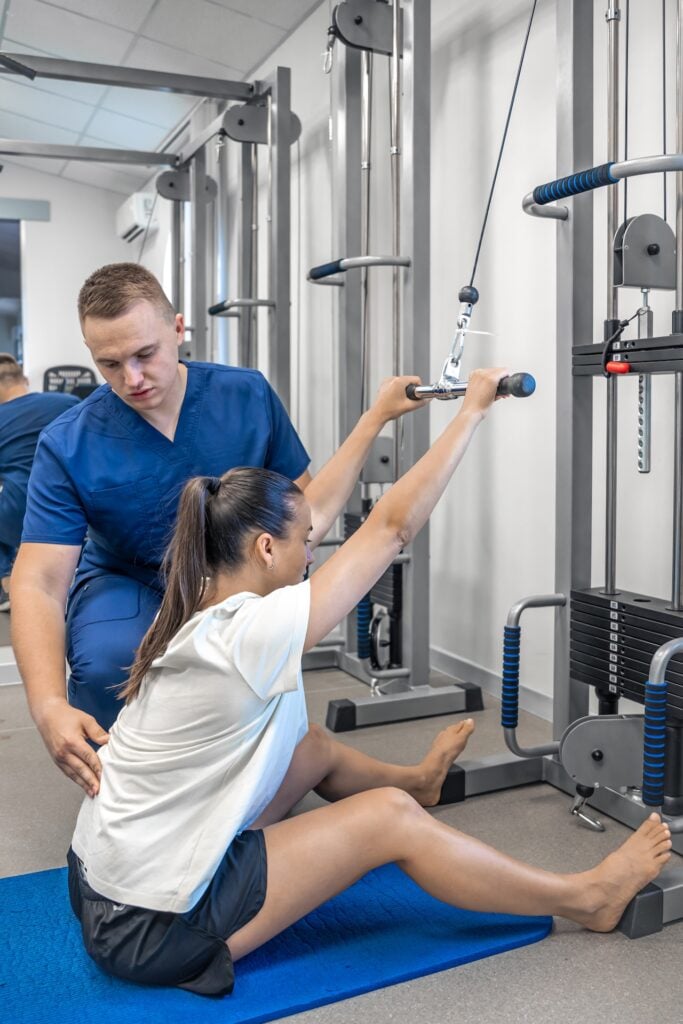
A physical therapist evaluates how a joint moves, how muscles fire in sequence, and where compensations have crept in. From there, movement is introduced in a controlled, progressive way — starting with gentle range-of-motion work, advancing to strengthening, and eventually incorporating the kind of functional movement the person needs for daily life, sport, or work. Every step is calibrated to the tissue’s current capacity, gradually asking it to do a little more.
This precision is what separates rehabilitative exercise from simply “staying active.” It’s not about generic fitness; it’s about restoring the specific mechanics that were disrupted.
How Movement Actually Promotes Healing
There’s a physiological reason targeted movement works so well. Controlled loading stimulates blood flow to injured tissues, delivering oxygen and nutrients that support repair. It also encourages collagen fibers in healing tendons, ligaments, and muscle to align in a functional pattern rather than forming a disorganized, weaker scar.
Movement also plays a role in retraining the nervous system. After an injury, the brain often becomes protective, altering movement patterns to avoid pain — even after the tissue itself has healed. This can lead to compensations that cause new issues elsewhere in the body. Targeted movement, guided by a skilled clinician, helps recalibrate these neural pathways, teaching the body that it’s safe to move naturally again.
The Role of Physical Therapy in Recovery
This is where physical therapy becomes indispensable. A physical therapist doesn’t just prescribe exercises; they build a progressive roadmap based on how tissue heals and how the body compensates. They know when to push and when to pull back, how to sequence exercises so one movement prepares the body for the next, and how to spot subtle compensations that could derail recovery if left unchecked.
Physical therapy also addresses the root cause, not just the symptom. If an ankle sprain happened because of poor hip stability, treating only the ankle leaves the door open for another injury. A comprehensive approach looks at the entire kinetic chain, ensuring that strength and mobility are restored where they’re actually needed.
Movement as Prevention, Not Just Recovery
Perhaps the most valuable part of targeted movement is what it does beyond the initial recovery. The strength, mobility, and body awareness built during physical therapy often leave people more resilient than they were before the injury. Instead of simply returning to baseline, many walk away with better movement quality, more balanced strength, and a deeper understanding of how their body works.
Injury recovery, done well, isn’t just about getting back to normal. It’s about building a body that moves better, adapts faster, and holds up against the demands of everyday life. That’s the real medicine — not rest for its own sake, but movement with purpose.